
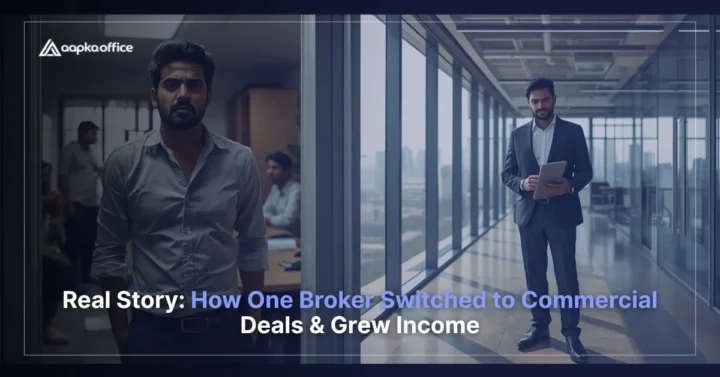
For nearly a decade, Rohan Sharma was a name synonymous with residential properties in Pune’s bustling suburbs. He knew the ins and outs of every 2BHK, every gated community, and every family looking for their “dream home.” He was good at his job, respected by his clients, and made a decent living.
But “decent” wasn’t cutting it anymore.
The residential market, once his playground, had become a battlefield. Cutthroat competition, clients with shrinking budgets, and the emotional rollercoaster of family decision-making were taking a toll. Deals would fall through at the last minute because of a Vastu disagreement or a family squabble. His income, once predictable, had become a series of frustrating peaks and valleys.
“Ek deal close karne mein mahino lag jaate the,” Rohan recalls, “aur end mein client bolta hai, ‘soch ke batate hain.’ It was exhausting.” (It would take months to close one deal, and in the end, the client would say, ‘We’ll think about it and let you know.’)
This is the story of how Rohan, a seasoned residential broker, made a calculated pivot into commercial real estate (CRE) and not only stabilized his income but tripled it in two years. His journey from showing kitchens to leasing office spaces is a masterclass for any broker feeling stuck in the residential grind.
The Tipping Point: Why Residential Was No Longer Enough
Every broker who has considered switching fields has their “tipping point.” For Rohan, it was a series of events that painted a clear picture.
- Income Instability: The commission from a residential rental was barely enough to cover his monthly expenses. Sales were lucrative but infrequent. He needed a more consistent, high-value cash flow.
- The Emotional Drain: He spent countless hours counseling families, mediating disputes, and being a part-time therapist. The emotional labor was immense and unpaid.
- Market Saturation: For every decent property, there were fifty other brokers competing for the same client. Digital platforms, while helpful, also increased the competition exponentially.
- The “What If” Moment: A chance conversation with a client who was looking for a small office space opened his eyes. The client was decisive, knew his requirements, and was ready to close quickly. The potential commission from that single deal was more than what he had earned in the last three months.
This was his lightbulb moment. What if he could deal with clients who thought in terms of square feet and ROI, not sentiment and kitchen layouts?
The First Step: Understanding the Beast—Residential vs. Commercial
Rohan didn’t just jump in. He spent the next three months educating himself. He learned that commercial and residential real estate are two different languages.
Here’s a breakdown of what he discovered:
| Feature | Residential Real Estate | Commercial Real Estate (CRE) | Rohan’s Key Takeaway |
| Client Type | Individuals & Families | Businesses, Investors, Corporations | CRE clients are professional, data-driven, and less emotional. |
| Deal Logic | Emotion-driven (dream home, lifestyle) | Business-driven (ROI, location, footfall) | The conversation shifts from “How does it feel?” to “How does it perform?” |
| Lease Terms | Short-term (11 months – 2 years) | Long-term (3 – 10+ years) | Longer leases mean more stable, long-term commission. |
| Income Potential | Lower, volume-based commission | Higher, value-based commission | One good commercial deal can be worth 10 residential deals. |
| Complexity | Simpler paperwork, basic legal checks | Complex paperwork, due diligence, zoning | Requires more learning but offers a higher barrier to entry (less competition). |
| Working Hours | Weekends & Evenings | Standard Business Hours (Mon-Fri, 9-6) | Better work-life balance. |
This table became his bible. He realized that while CRE was more complex, the rewards were significantly higher and more predictable.
Rohan’s Action Plan: A 5-Step Guide to Making the Switch
Rohan’s transition was methodical. He didn’t abandon his residential clients overnight but built his commercial practice brick by brick. Here is the exact blueprint he followed.
Step 1: Education & Mentorship—”Seekhna “Padega” (I have to learn)
Rohan knew he couldn’t afford to make rookie mistakes.
- He Took Courses: He enrolled in online courses on commercial real estate fundamentals, learning about things like lease structures (gross, net, and triple net), zoning regulations, and property valuation metrics (cap rate and ROI).
- He Found a Guru: He identified a veteran commercial broker in his city and offered to work with him on a referral basis. He’d pass on any commercial leads he got in exchange for a small commission and, more importantly, the chance to shadow him on deals. This mentorship was priceless.
- He Read Everything: He subscribed to industry publications, followed CRE news, and learned the jargon. He needed to sound like an expert before he could become one.
Step 2: Building a Niche & a Network
The world of CRE is vast—office, retail, industrial, warehouse. Rohan decided to start with a niche he understood: small office spaces for startups and SMEs. Pune was a startup hub, and this was a market he could tap into.
- Networking 2.0: He stopped attending just property fairs and started going to business networking events, startup meetups, and trade shows. He wasn’t there to sell; he was there to listen and learn about what businesses needed.
- Leveraging LinkedIn: He revamped his LinkedIn profile, positioning himself as a “Commercial Real Estate Advisor for Startups.” He started connecting with founders, CEOs, and admin heads of local companies.
- Partnering with Professionals: He built relationships with architects, interior designers, and business consultants—professionals who were often the first to know when a company was looking to expand.
Step 3: Curating the Right Kind of Inventory
His residential list was useless here. He needed a new, specialized inventory.
- Scouting & Surveying: He spent his weekends driving through commercial districts, noting down “For Lease” signs, and calling the numbers. He built his own database from the ground up.
- Focusing on Quality: He learned to evaluate commercial properties based on a new set of criteria:
- Location & Accessibility: Proximity to transport hubs and main roads.
- Infrastructure: Power backup, internet connectivity, parking.
- Building Quality: Age of the building, maintenance, security.
- Scalability: Could the client expand in the same building later?
- Using Technology: This is where he discovered the power of platforms designed for professional brokers. Instead of a scattered Excel sheet, he started using tools that helped him manage his listings, track leads, and present properties professionally. A platform like Aapka Office can be invaluable here, offering a structured way to showcase verified commercial listings and connect with a network of other credible brokers.
Step 4: The First Deal—From Theory to Practice
His first commercial lead came from a referral from his mentor. It was a tech startup looking for a 2,000 sq. ft. office. Rohan was nervous, but he was prepared.
- He Did His Homework: Before the first meeting, he knew the client’s business, their funding stage, and their potential growth trajectory.
- He Spoke Their Language: Instead of saying, “This office has a great view,” he said, “This location offers excellent branding visibility, and the layout is optimized for a 20-person team with room to grow.”
- The Site Visit Checklist: He created a checklist for his clients, helping them evaluate properties systematically.
- [ ] Power backup (Genset capacity?)
- [ ] Number of car parks
- [ ] Internet service providers available
- [ ] Security and access control
- [ ] Common area maintenance (CAM) charges
- [ ] Lock-in period and escalation clause
The client was impressed. They saw him not as a salesman but as a business advisor. He closed the deal in three weeks. The commission check was more than he had ever earned from a single transaction.
Step 5: Scaling Up—Building a Brand
With his first success, Rohan was hooked. He reinvested his earnings into building his brand.
- He specialized further: he became the go-to guy for tech and SaaS startups in his area.
- He Built a Digital Presence: He started a simple blog where he shared tips for companies looking for office space. This established him as a thought leader.
- He Leveraged Testimonials: He asked his happy corporate clients for testimonials and featured them on his profile on platforms like Aapka Office, which amplified his credibility. This social proof was crucial for attracting bigger clients.
The Results: A Tale of Transformation
Two years after making the switch, Rohan’s business is unrecognizable.
- Income: His annual income has grown by over 300%.
- Stability: He now has a steady stream of income from long-term leases and recurring clients.
- Work-Life Balance: He works smarter, not harder. His weekends are now his own.
- Professional Respect: He is no longer just a “broker” but a respected “commercial real estate consultant.”
FAQs: Your Questions on Switching to Commercial Real Estate
Q: Is it necessary to have a background in finance or business to succeed in CRE? A: Not at all. Like Rohan, you can learn on the job. What’s more important is a professional attitude, a willingness to learn, and strong networking skills.
Q: How do I manage my finances during the transition period? A: Don’t quit your residential business cold turkey. Phase it out. Use the income from your existing residential deals to fund your education and networking efforts in the commercial space.
Q: What is the biggest mistake new commercial brokers make? A: Trying to be everything to everyone. The key to success in CRE is finding a niche. Whether it’s retail, office space, or warehouses, become an expert in one domain before you diversify.
Q: How can platforms like Aapka Office help in this transition? A: Platforms like Aapka Office are crucial for building credibility quickly. By getting a verified profile, you signal to serious corporate clients that you are a professional. It also provides you with the tools to manage your listings and a network of other verified brokers to collaborate with, which is essential when you are starting out.
Your Turn: Is It Time to Make the Switch?
Rohan’s story is not an overnight success. It’s a story of strategy, hard work, and the courage to step out of a comfort zone. If you’re a residential broker feeling the burnout, ask yourself:
- Are you tired of the emotional drain and income instability?
- Are you looking for a more professional and financially rewarding career path?
- Are you willing to invest the time to learn a new, more complex field?
If the answer is yes, then the world of commercial real estate might be waiting for you. Start small, educate yourself, find a mentor, and build your network. The journey is challenging, but as Rohan proved, the destination is more than worth it.
Ready to explore a new direction in your real estate career?
Create your professional broker profile on Aapka Office and start building your brand in the commercial space today.
Connect with a network of verified professionals and unlock your true earning potential.


