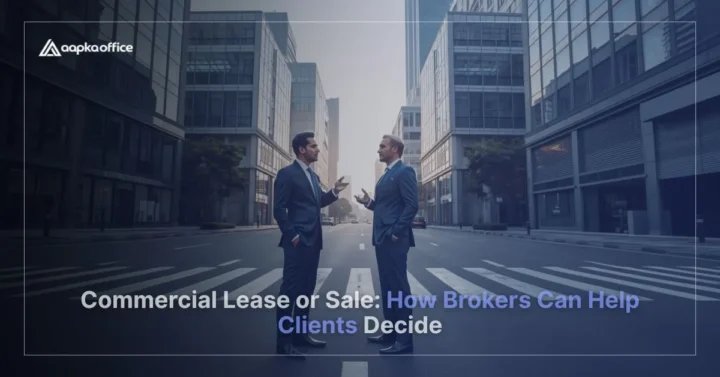
It’s one of the most pivotal questions a business owner will ever face, and as a real estate broker, you’re standing right at the center of it.
Your client, a successful entrepreneur, turns to you and asks, “Mera business aacha chal raha hai. Ab, main road pe yeh property kiraye pe lein ya seedha khareed lein? Aap batao.” (My business is doing well. Now, should I lease this property on the main road or just buy it outright? You tell me.)
How you answer this question separates the transactional brokers from the transformational advisors. A transactional broker might see a bigger commission in a sale and push for that. An advisor understands that this isn’t just a property decision; it’s a fundamental business strategy decision that will impact the client’s cash flow, flexibility, and long-term growth.
Guiding a client through the “lease vs. buy” dilemma is one of the most valuable services you can offer in commercial real estate (CRE). It’s your opportunity to move beyond showing spaces and start providing strategic counsel. This guide will equip you with the framework, questions, and data to help your clients make the smartest choice for their business, cementing your role as their trusted, indispensable partner.
The Fundamental Choice: Capital Flexibility vs. Asset Control
Before diving into the numbers, it’s crucial to frame the decision correctly for your client. This isn’t about “rent vs. EMI.” It’s a strategic trade-off between two powerful business advantages:
- Leasing is about OPERATIONAL FLEXIBILITY. It’s a strategy to keep capital liquid and stay agile. The business pays for the use of a property without being tied down by ownership.
- Buying is about ASSET CONTROL. It’s a strategy to build long-term value and have complete command over a physical asset. The business owns a piece of its operational foundation.
Your first job as an advisor is to help your client understand which of these two advantages is more critical for their business at its current stage.
The Strong Case for Leasing: The Power of Being Nimble
For the vast majority of businesses in India, especially startups and SMEs, leasing is the more prudent choice. Here’s how to explain the benefits to your client.
1. It Preserves Precious Capital
This is the number one reason. Buying a commercial property requires a massive capital outlay—typically a 20-30% down payment, plus registration costs.
Your Advisory Angle: Ask your client, “If you didn’t have to put ₹50 lakhs into a down payment, what could you do with that money for your business? Could you hire more staff, increase your marketing budget, or invest in new technology?” This reframes the down payment as an “opportunity cost.” For most businesses, capital invested in their own growth generates a much higher return than capital sunk into real estate.
2. It Provides Unmatched Flexibility
Business is unpredictable. A company might double in size in two years or pivot to a new market.
Your Advisory Angle: A standard commercial lease is for 3-5 years. This gives the business a defined exit point. If they outgrow the space, they can move. If they need to downsize, they can relocate at the end of the term. Buying a property locks them into a single location and size. Selling a commercial property is a slow and complex process if their needs change. Leasing keeps them agile.
3. Lower & Predictable Upfront Costs
The initial cash required for a lease is a security deposit (typically 3-6 months’ rent) and one month’s rent in advance. This is a fraction of a down payment.
Your Advisory Angle: This makes starting or expanding a business far less capital-intensive. The lower entry barrier allows businesses to get up and running faster.
4. Access to Prime Locations
A business might not have the ₹10 crores needed to buy an office in a premium business district, but they can likely afford the ₹5 lakhs monthly rent.
Your Advisory Angle: Leasing provides access to prestigious addresses and prime locations that would be impossible to own. This can be critical for brand image and attracting talent.
5. Hassle-Free Maintenance & Management
In most lease agreements, the landlord is responsible for the building’s structural integrity, property taxes, and major maintenance.
Your Advisory Angle: This allows the client to focus on their core business, not on fixing a leaky roof or dealing with municipal compliance. They are outsourcing the headache of property ownership.
6. Clear Tax Advantages
The entire amount paid as rent is considered an operational expense and is 100% tax-deductible from the business’s income. This is a simple and significant financial benefit.
The Strong Case for Buying: The Power of Owning Your Foundation
Buying isn’t for everyone, but for the right kind of business, it’s a powerful wealth-creation and stability strategy.
1. You Are Building a Tangible Asset
This is the most significant advantage. The property becomes a valuable asset on the company’s balance sheet.
Your Advisory Angle: Over the long term, commercial property has the potential for significant capital appreciation. This creates a second, parallel source of wealth for the business owner, separate from the company’s operational profits.
2. Absolute Control and Stability
The business owner is their own landlord.
Your Advisory Angle: You have complete control over the property. You can renovate, reconfigure, and customize the space to your exact needs without seeking anyone’s permission. You are also immune to the landlord deciding not to renew the lease or imposing a steep rent escalation. This provides immense peace of mind for stable, long-term businesses.
3. A Potential New Income Stream
If a business buys a property larger than its current needs, it can lease out the extra space.
Your Advisory Angle: The rental income from the leased portion can help cover the EMI and other ownership costs, effectively subsidizing your own occupation.
4. A Legacy for the Future
For established, multi-generational family businesses or institutions like hospitals and schools, owning their property is part of their identity and long-term vision.
Your Advisory Angle: Ownership signifies permanence, stability, and a commitment to the future.
5. Tax Benefits Through Depreciation
While they can’t deduct an EMI, business owners can claim tax benefits on the annual depreciation of the building’s value, which can provide some financial relief.
The Advisor’s Checklist: 5 Questions to Guide Your Client
To be a true advisor, you need to become a consultant. Use these five questions to facilitate a strategic discussion with your client.
| Strategic Question | If the Client Answers… | The Likely Best Path |
| 1. What is your business’s stage? | “We’re a high-growth startup.” / “We’re still figuring things out.” | Lease. They need flexibility above all else. |
| “We’re a stable, profitable business with a 20-year track record.” | Buy. They have the stability to consider a long-term asset. | |
| 2. What is your capital situation? | “Every rupee is needed for inventory and marketing.” | Lease. Capital preservation is key. |
| “We have significant cash reserves and access to easy credit.” | Buy. They can afford the down payment without starving the business. | |
| 3. How predictable are your space needs? | “We might grow from 50 to 150 employees in 3 years.” | Lease. Their need for space is dynamic. |
| “Our factory layout and machinery are fixed for the next decade.” | Buy. Their space requirement is static and predictable. | |
| 4. How important is a prime location? | “We need to be in the most expensive business district to attract clients.” | Lease. It’s likely the only affordable way to get that address. |
| “We can operate from a less central industrial area.” | Buy. Owning in a less prime, more affordable area is feasible. | |
| 5. Do you want to be a property manager? | “I only want to focus on my business, not on building issues.” | Lease. They want to outsource property management. |
| “I enjoy managing assets and don’t mind the extra responsibility.” | Buy. They have the appetite for property ownership. |
This structured conversation elevates you from a property finder to a business consultant. This is the kind of value that builds a stellar reputation, and platforms like Aapka Office are designed to help you showcase this advisory-led approach through a professional, verified profile.
FAQs: Answering the Nitty-Gritty
Q: As a broker, is my commission better on a sale or a long-term lease? A: A sale provides a large, one-time commission (typically 1-2% of the property value). A long-term lease provides a smaller commission (e.g., 1-2 months’ rent), but you may get it again upon renewal. A sale is a bigger immediate payday, but a portfolio of lease deals can provide a more stable, recurring income. The best deal is the one that’s right for your client, as that’s what builds a long-term referral business.
Q: What is a ‘lease-to-own’ or ‘rent-to-own’ option? A: This is a hybrid agreement where a portion of the monthly lease payment is set aside and credited towards a down payment if the tenant decides to buy the property at a later, pre-agreed date and price. It’s less common in India but can be a good middle path for some businesses.
Q: My client is a doctor who wants to set up a clinic. Should they lease or buy? A: This is a classic case for a deep discussion. A new doctor might lease to test a location. A very established doctor with a large practice and a long-term commitment to a neighborhood would be a prime candidate for buying, as their location is integral to their personal brand and patient base.
Conclusion: Your Value Is in Your Guidance
The decision to lease or buy a commercial property is complex, with significant long-term consequences. Your client isn’t just looking for a space; they are looking for clarity, confidence, and an expert to guide them.
When you shift your focus from “closing the deal” to “facilitating the best decision,” you fundamentally change your relationship with your client. You become their strategic partner. This is the path to building a business based on trust, referrals, and an impeccable professional reputation.
Whether your client ultimately decides to lease or buy, a platform like Aapka Office provides a reliable source of verified listings for both categories, ensuring that once the strategic decision is made, the property search is safe and efficient.
So, the next time a client asks you, “Should I lease or buy?”—smile. You’re not just about to make a deal; you’re about to build a legacy of trust.
Ready to position yourself as a strategic real estate advisor?
Create your professional, verified profile on Aapka Office and showcase the expertise that serious clients are looking for.
Guide your clients with confidence and build a brand that stands for more than just transactions.


